
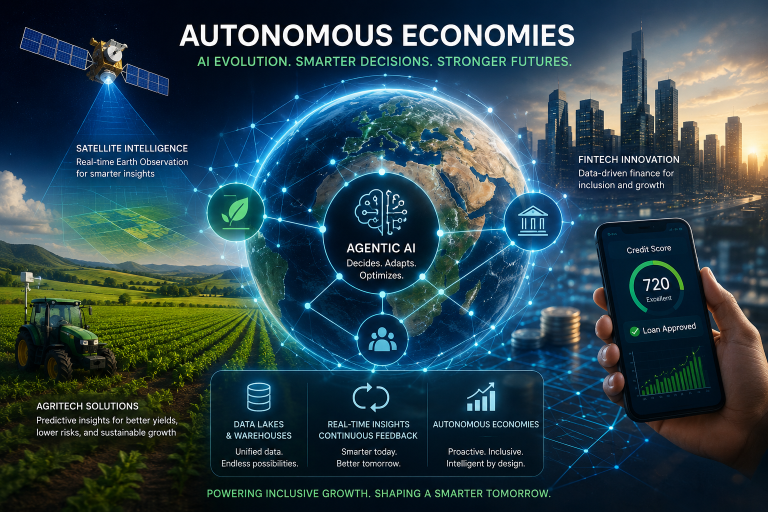
Autonomous Economies and AI Evolution
The next evolution of global markets will not be driven by both data and systems that can act on it. Autonomous economies, powered by Agentic AI, satellite intelligence, and advanced financial technologies, will likely merge as powerful forces capable of redefining how societies produce, distribute, and grow wealth.
At the center of this shift is Agentic AI: intelligent systems that move beyond passive analytics to actively make decisions, adapt to changing conditions, and continuously optimize outcomes. When combined with Earth Observation Data (EOD) from satellites, these systems gain a real-time understanding of the physical world, tracking climate patterns, agricultural productivity, infrastructure development, and economic activity at unprecedented scale. This fusion can unlock powerful applications for both fintech and agritech. Farmers, for instance, can access predictive insights on crop yields, weather risks, and soil conditions, enabling smarter planning and increased productivity. Financial institutions can include geospatial data in making credit decisions, potentially expanding access to finance for under-served populations while reducing risk.
Underpinning these capabilities are modern data lakes and warehouses, which unify vast streams of structured and unstructured data into cohesive intelligence layers. These infrastructures enable seamless integration between AI systems and real-world inputs, creating a feedback loop where decisions continuously improve over time.
The result is a new economic paradigm: systems that are proactive rather than reactive, inclusive rather than restrictive, and intelligent by design. Autonomous economies have the potential to accelerate socio-economic development, particularly in emerging markets, where traditional infrastructure gaps can be bypassed through advanced technology.
As companies like FCL BLOOMTECH Limited, a subsidiary of FRIENDS Consult Ltd, pioneer this convergence, the vision of self-optimizing, data-driven economies are rapidly moving from theory to reality.
Dr. Keren Obara.
Projects Officer, Marketing and Innovation.